
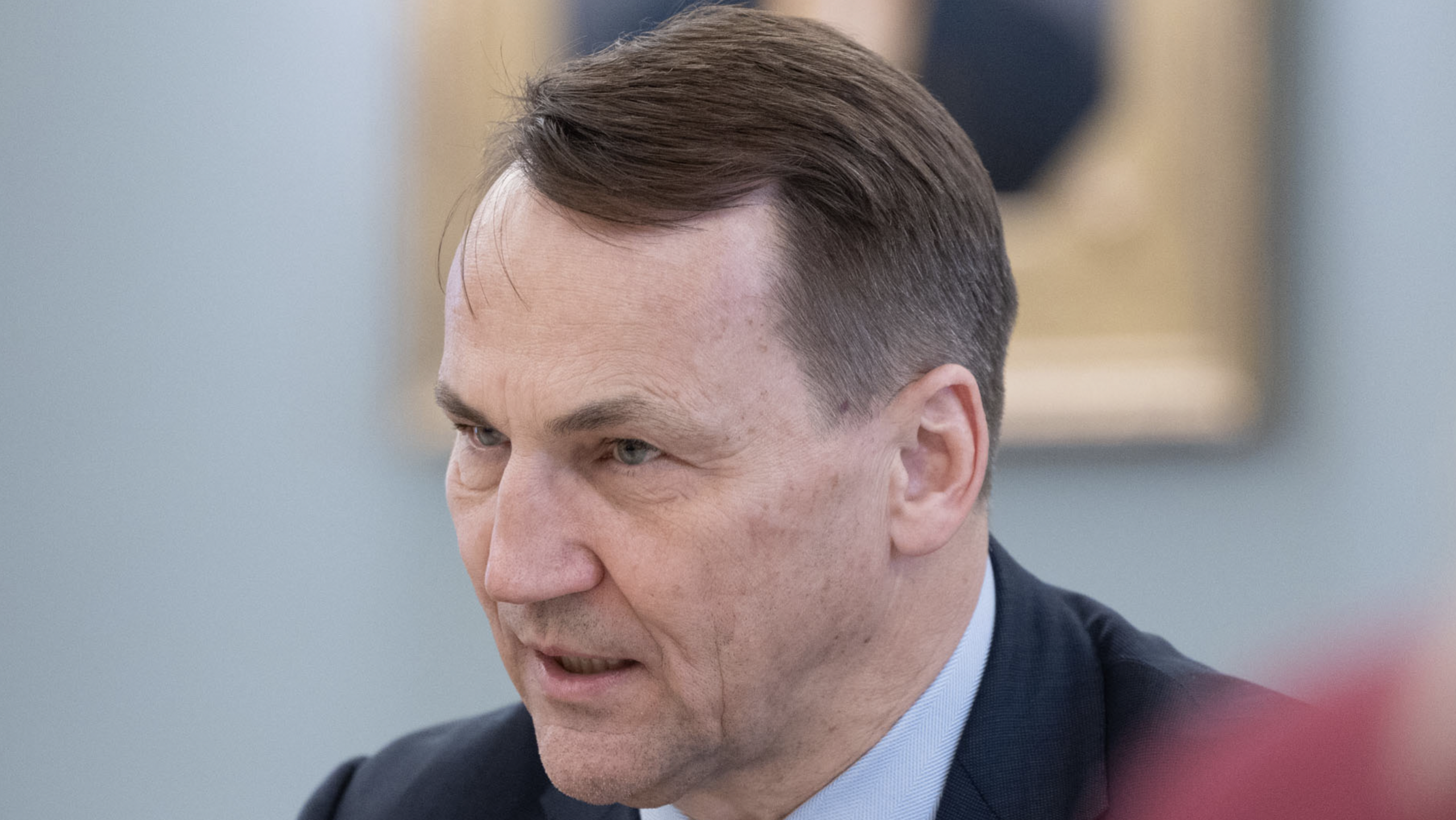
Speaking at a panel during the Munich Security Conference, Poland’s Deputy Prime Minister Radosław Sikorski challenged what he described as persistent myths surrounding migration policy and the structure of the European Union. His remarks addressed both American and European political narratives, arguing that debates over migration and sovereignty are frequently mischaracterized along ideological lines.
Polish Foreign Minister Sikorski:
— Clash Report (@clashreport) February 14, 2026
It is a complete falsehood to claim that mass migration was a left-wing project.
For decades, it was supported by Republican businessmen who wanted cheap labor from Latin America in the United States. pic.twitter.com/6l6VLwPWHg
Sikorski rejected the notion that large-scale migration has historically been a project of the political left. “I think it’s a complete falsehood to claim that mass migration was a left-wing project,” he said. “It was for decades supported by Republican businessmen who wanted cheap labor from Latin America in the United States.”
His comments reference longstanding debates in U.S. politics over immigration policy, where business interests have often aligned with expanded labor access. Throughout the late 20th century and early 21st century, sectors including agriculture, construction and service industries relied heavily on migrant labor, and immigration reform proposals frequently drew support from business groups seeking workforce expansion. Sikorski argued that similar economic motivations have shaped migration policy in Europe. “It’s also a complete falsehood to suggest the same narrative applies in Europe,” he said. “In Europe, migration has likewise been supported in pursuit of economic growth.”
He pointed to Poland’s own actions as evidence that border control is not inherently ideological. “The government in Poland built a large and effective fence on our border with Belarus in two years,” he said. The barrier, constructed after a surge in migrant crossings from Belarus into Poland beginning in 2021, was part of Warsaw’s broader response to what it described as a coordinated effort by Minsk to channel migrants toward the European Union’s eastern frontier.
Polish Foreign Minister Sikorski:
— Clash Report (@clashreport) February 14, 2026
We built a fence on our border with Belarus that protects all of Europe from forced migration.
They (the U.S) haven’t yet completed their “big and beautiful” fence.
On migration, we agree with the United States — but we feel we’ve done more… pic.twitter.com/I7KpFwaUlX
For Sikorski, the broader principle at stake is sovereignty rather than partisanship. “It’s not a left-wing or right-wing issue. It’s about whether we agree that we have the right to control who comes in and who doesn’t. That idea is not inherently left-wing or right-wing,” he said. He framed the debate in terms of economic and social trade-offs. “You can have open borders, as Australia and the United States did in the 19th century, or you can have a welfare state. You cannot have both at the same time without risking serious problems,” he said, referring to periods of relatively unrestricted migration during the 1800s before the development of modern social safety nets.
Sikorski also addressed criticism of the European Union’s democratic legitimacy. “It is also completely false to suggest that the European Union is undemocratic,” he said. “I was a member of the European Parliament. I was democratically elected. It is a democratic chamber. The European Commission is nominated by democratically elected governments of Europe.”
When pressed by the interviewer to clarify his central argument, Sikorski expanded his point beyond migration policy. “The point I’m making is that there are other forms of democracy beyond the nation-state model,” he said. “We have constructed a democratically governed European Union, and the myth that led to Brexit—that Brussels bureaucrats are imposing directives on member states—is simply not true. That is not how the European Union works.”
Polish Foreign Minister Sikorski:
— Clash Report (@clashreport) February 14, 2026
This myth that gave us Brexit—that somehow Brussels bureaucrats are imposing directives on member states—is complete nonsense.
That’s not how the European Union works. pic.twitter.com/74L5r9J3bj
His reference to Brexit alluded to arguments made during the United Kingdom’s 2016 referendum campaign, in which critics of EU membership frequently framed the bloc as imposing rules on national governments without sufficient democratic accountability. The EU’s institutional structure, however, includes the directly elected European Parliament and a European Commission appointed by member state governments, which are themselves elected domestically.
Sikorski’s remarks come amid renewed political debate across Europe and the United States over migration levels, border enforcement and national sovereignty. Several European governments have tightened border controls in recent years in response to increased migration flows, while EU institutions have worked to reform asylum and migration rules at the bloc level.
By challenging the framing of migration as a purely ideological project and defending the EU’s democratic credentials, Sikorski positioned the discussion as one centered on governance choices and institutional design rather than partisan identity. His intervention underscored the continued salience of migration and sovereignty in transatlantic political discourse.


