
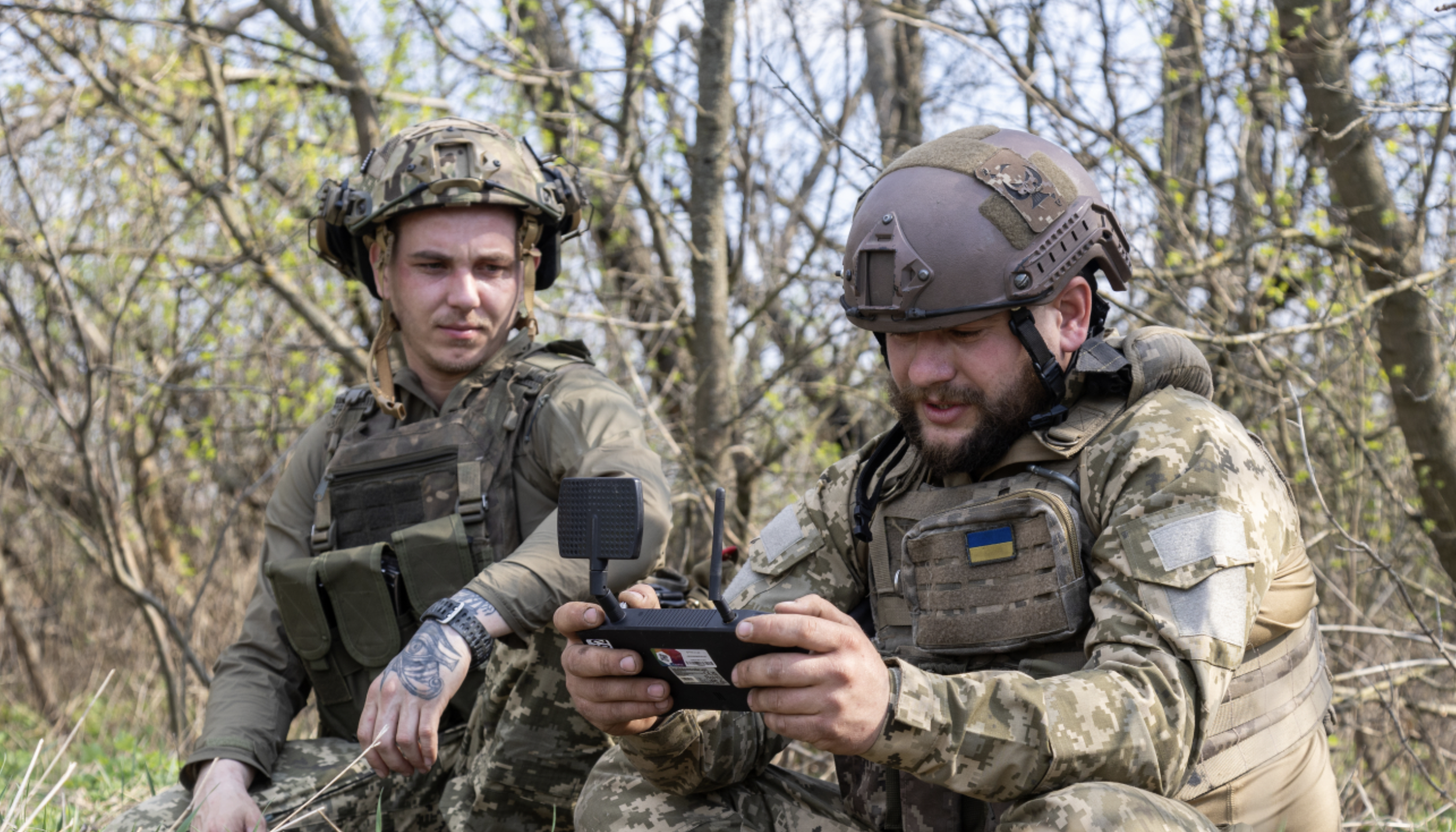
Ukraine is increasingly using interceptors to destroy Russian drones, and the best pilots are often young video game aces.
The Russian drone hovered menacingly above a wounded Ukrainian soldier, poised to drop a bomblet and finish him off. Suddenly, a Ukrainian drone smashed into the Russian craft at high speed, blowing it up and saving the soldier’s life. This dramatic rescue, executed by a pilot from Ukraine’s 3rd Separate Assault Brigade, highlights a rapidly evolving tactic in the war: flying interceptor drones directly into enemy aircraft to bring them down.
Why it Matters
Countering the enemy’s unmanned aerial vehicles (UAVs) has become a critical challenge for both Moscow and Kyiv, as these craft have evolved into the deadliest weapons menacing infantry and vehicles on the front lines. While soldiers have utilized everything from nets and shotguns to electronic jammers and aging prop planes to disable them, interceptor craft have become an essential part of the defensive mix over the past year.
As defense analysts note, these aerial dogfights are likely to be a permanent component of future combat. Defense companies are now rushing to develop their own specialized interceptors, signaling a shift in how modern air superiority is contested.
What to Know
The effectiveness of these drone-on-drone tactics has skyrocketed. According to Artem Boliukh, chief of the air-defense unit for the 3rd Separate Assault Brigade, his team’s drones intercepted 886 Russian drones in September, a sharp increase from 507 in June. Boliukh notes that around 50 percent of missions now result in a successful interception, compared with just 5 percent a year ago. When an interceptor misses, operators are often able to recover the device for reuse.
A key factor in this success is the demographic of the pilots. Many top operators are young people with reaction times honed on videogames. One standout pilot, a 24-year-old former computer-game developer known by the call sign “Kratos,” has achieved Ukraine’s highest tally for intercepting Russian reconnaissance drones since late January. Kratos, who was awarded Ukraine’s Cross of Combat Merit in October, claims over 380 confirmed interceptions.
Different threats require different tools. To combat Russia’s long-range Shahed drones, which pummel Ukrainian cities, defenders use high-speed interceptors like “Merops.” Produced by a company founded by former Google CEO Eric Schmidt, Merops uses artificial intelligence to lock onto targets. One user reported that the system, which costs roughly $15,000 according to a U.S. official, can travel over 180 miles an hour and reach altitudes of 16,000 feet.
What People are Saying
The evolution of this tactic was not guaranteed. “Nobody believed that it could be possible at all” 15 months ago, said Artem Boliukh. He explained that engineers had to overcome significant hurdles regarding range and operator safety, while pilots had to learn to engage targets in extremely narrow windows of time. “Modern warfare changes very quickly,” Boliukh added.
For the pilots, the work is high-stakes and personal. Kratos, the pilot who saved the wounded soldier after intercepting a Russian radio tip-off, described the reality of the job: “It is the stuff that happens in movies, TV shows and books, but here we are in life and death situations every day.”
However, the job comes with difficult choices. Anton Mykhailov, a drone co-pilot, described instances where crews must decide between risking a valuable interceptor or letting a target go. In one case, a Shahed drone disappeared into the clouds after a chase was called off to save the interceptor; the team later learned the Russian drone struck a school. “We are not magicians,” said Ruslan Stakhov, a junior sergeant who watched a Shahed he couldn’t catch destroy a house where he once fixed his car. “It was very upsetting, but that is a typical situation in war.”
What Happens Next
Western defense firms are accelerating development to meet the demand. Swedish startup Nordic Air Defence is testing lightweight interceptors capable of smashing into drones at altitudes up to 6,000 feet. Meanwhile, Poland has indicated it would order the Merops system after testing.
Despite the technological advances, limitations remain. Yuriy Ihnat, a spokesman for Ukraine’s air force, noted that poor weather can still blind operators, meaning traditional bullets and missiles remain the predominant defense.
On the ground, units like the 3rd Separate Assault Brigade are taking matters into their own hands, operating laboratories to assemble drones from imported components and 3D-printed parts. As the number of Russian craft grows, operators say the need for more interceptors is urgent, ensuring that the battle for the skies will only intensify in the coming months.


