
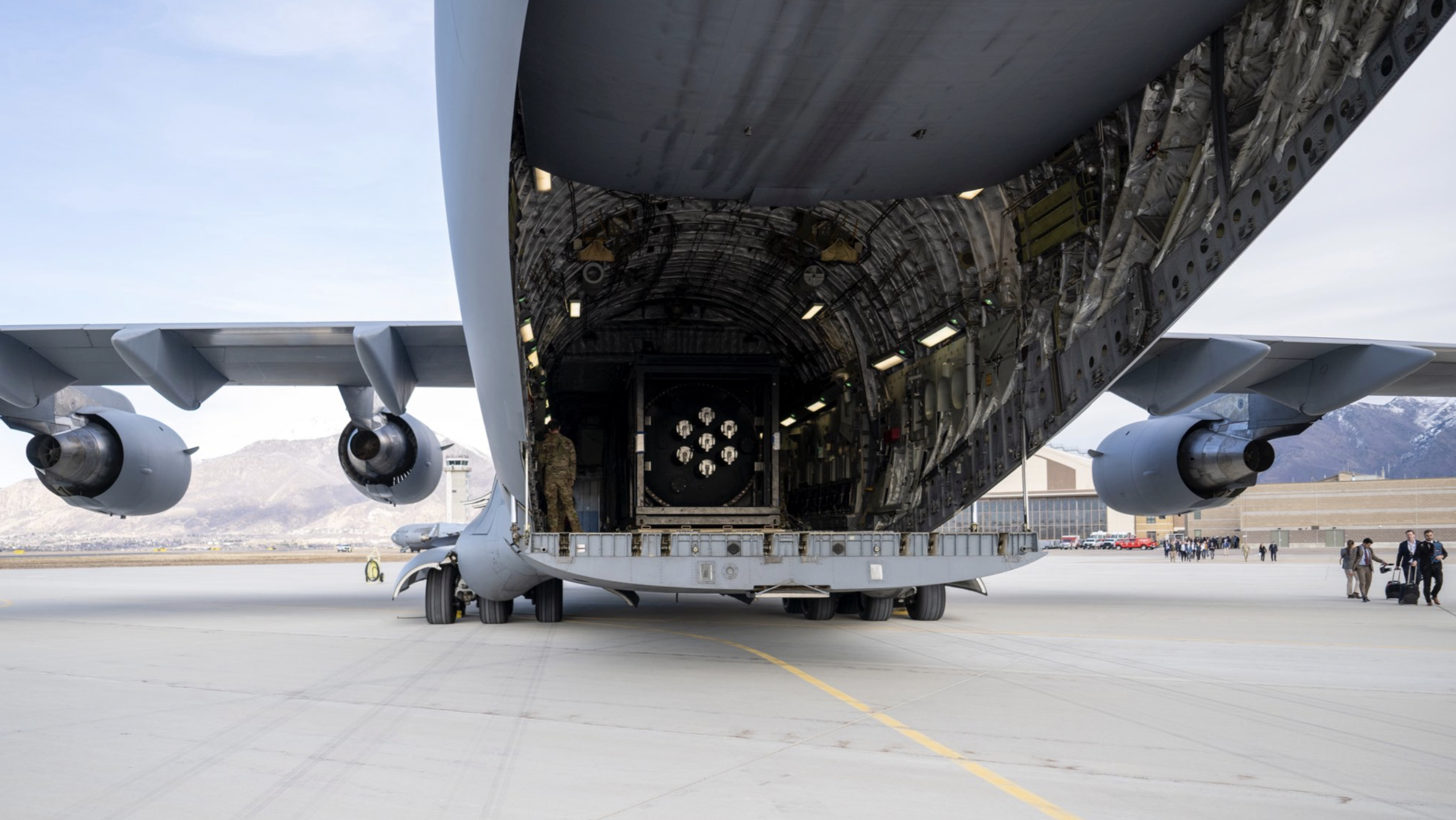
The United States on Sunday for the first time transported a small nuclear reactor by cargo plane from California to Utah, in a demonstration aimed at showing how nuclear power could be rapidly deployed for military and civilian use, according to Reuters and federal officials.
The Departments of Energy and War partnered with Valar Atomics to fly one of the company’s Ward microreactors on a C-17 aircraft from March Air Reserve Base to Hill Air Force Base, the agencies said. The reactor was transported without nuclear fuel.
Energy Secretary Chris Wright and Under Secretary of War for Acquisition and Sustainment Michael Duffey were aboard the flight, according to Reuters. Duffey said the effort could help allow nuclear power to be deployed “when and where it is needed” for U.S. forces.
The U.S. Air Force said its 452nd Logistics Readiness Squadron airlifted an unfueled, next-generation Ward250 mini nuclear reactor built by Valar Atomics aboard a C-17A from March Air Reserve Base on Feb. 15, marking the first-ever reactor airlift, with modules bound for testing… pic.twitter.com/XbnCesHZtR
— Open Source Intel (@Osint613) February 16, 2026
Following its arrival at Hill Air Force Base, the reactor was scheduled to be moved to the Utah San Rafael Energy Lab for testing and evaluation, according to a statement from the Department of War.
The Department of War said the project aligns with President Donald Trump’s executive orders aimed at expanding domestic nuclear energy production. The administration has promoted small nuclear reactors as one option to meet growing power demand tied to national security and advanced computing.
Valar Atomics said its Ward reactor is designed to generate up to 5 megawatts of electricity, enough to power about 5,000 homes. Chief executive Isaiah Taylor told Reuters the reactor will initially operate at lower power levels later this year before ramping up toward full capacity.
Today, we’re exited to partner with the Department of War and Department of Energy on Operation Windlord. Three C-17s will be transporting our Ward250 reactor from March ARB to Hill AFB.
— Valar Atomics (@valaratomics) February 15, 2026
Here’s a peek at what it took to bring this operation to life. (Part 1) pic.twitter.com/aQR2l9aTd3
Supporters of microreactors say they could provide energy in remote or austere locations and reduce reliance on diesel generators, which require frequent fuel deliveries. Critics argue the technology has not yet demonstrated that it can produce electricity at a competitive cost.
“There is no business case for microreactors, which — even if they work as designed — will produce electricity at a far higher cost than large nuclear reactors,” said Edwin Lyman, director of nuclear power safety at the Union of Concerned Scientists.
The Energy Department plans for three microreactors to reach “criticality,” when a nuclear reaction becomes self-sustaining, by July 4, Wright said. Fuel for Valar’s reactor will be shipped separately from the Nevada National Security Site to the Utah test facility, he told reporters.
Valar Atomics said on social media that three C-17 aircraft were used to transport reactor components as part of what it called “Operation Windlord.”
Defense analyst Brent Sadler, who said he observed the transport, wrote on social media that the reactor was moved in multiple parts on eight cargo pallets and will undergo fueling and initial criticality testing in Utah later this year.
Utah Governor Spencer Cox and U.S. Senator John Curtis also attended events surrounding the arrival of the reactor. Curtis wrote on social media that the transport marked the first time a nuclear reactor had been moved by C-17 aircraft and said expanding nuclear power was critical to U.S. energy independence and national security.
Today marks a historic milestone for American energy. 🇺🇸@Valaratomics' next-generation nuclear reactor was airlifted to Hill Air Force Base aboard three C-17s. Deployable nuclear is here.
— Governor Cox (@GovCox) February 15, 2026
Through Operation Gigawatt, Utah is doubling energy production and creating an ecosystem… https://t.co/fsfh0RJP7U pic.twitter.com/JxvevbuLIN
Federal officials said the demonstration was intended to test logistics and regulatory processes as well as the technology itself. The Energy Department has said it is in talks with several states, including Utah, about possible sites for nuclear fuel reprocessing or long-term waste disposal, though no decisions have been announced.


