
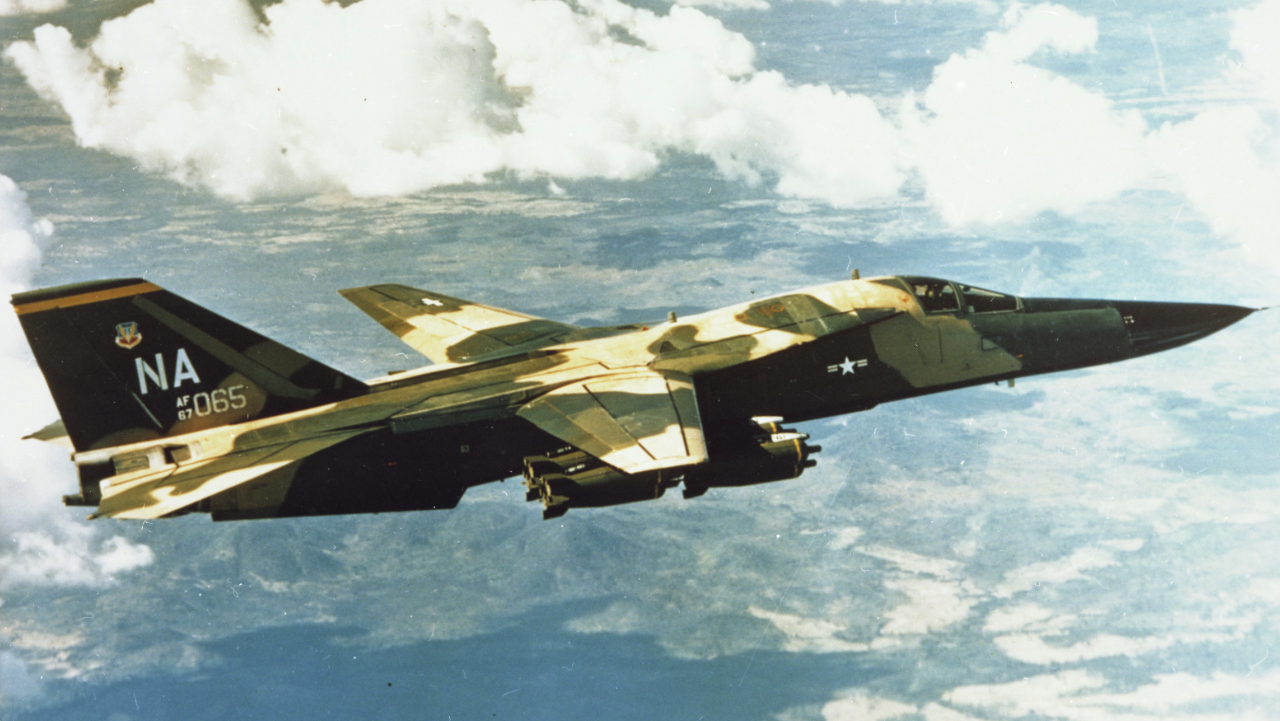
The F-111 Aardvark wasn’t just fast—it was revolutionary. With variable-sweep wings, terrain-following radar, and a fully ejectable cockpit, this Cold War marvel pushed the boundaries of what military jets could do. But despite all the innovation, Australia buried 23 of these aircraft in a landfill near Ipswich after their retirement.
A Shape-Shifting Pioneer
The F-111 was the first production aircraft to feature variable-sweep wings, also known as swing wings. The wings could be straight for takeoff, landing or slow speed flight, but by sweeping its wings rearward, it could exceed twice the speed of sound. This revolutionary design allowed the aircraft to adjust its wing configuration based on mission requirements.
The wing provided outstanding aerodynamic efficiency—with wings fully extended, the F-111 could take off and land in as little as 2,000 feet. With wings fully swept back, it could reach supersonic speeds at high or low altitudes. At high altitudes, the F-111 could fly more than 2.2 times the speed of sound.
Revolutionary Technology
The F-111 pioneered several technologies for production aircraft, including variable-sweep wings, afterburning turbofan engines, and automated terrain-following radar for low-level, high-speed flight. The terrain-following radar was particularly groundbreaking, allowing the aircraft to hug the terrain and navigate at low level in all weather conditions.
The F-111 was capable of navigating at low level to reach targets deep in enemy territory and deliver ordinance on the target. It was designed as an all-weather attack aircraft, capable of low-level penetration of enemy defenses.
One of the most distinctive features was the crew escape module. Unlike traditional ejection seats, the entire cockpit was designed to eject as a capsule, providing better protection for the two-person crew in emergency situations. The cockpit featured side-by-side seating for a pilot and weapons systems officer.
Cold War Development
The F-111 was developed in the 1960s by General Dynamics and first entered service in 1967 with the United States Air Force. In 1960, the Department of Defense combined the Air Force’s requirement for a fighter-bomber with a Navy need for an air superiority fighter, though the Navy eventually cancelled its program.
The F-111 set a record for the longest low-level supersonic flight—172 miles at less than 1,000 feet altitude—on November 9, 1966. It was also the first tactical aircraft to cross the Atlantic from the United States to Europe without refueling in May 1967.
Combat Service
The F-111 first went into combat over Vietnam beginning in the late 1960s, being flown as a penetrating bomber in both high-altitude and low-altitude missions. Nearly two decades later, US Air Force F-111F crews from RAF Lakenheath, England, used the highly accurate Pave Tack laser-guided bombing system against terrorist targets in Libya during Operation El Dorado Canyon in 1986.
In January 1991, the F-111 went to combat again in the initial bombing raids of Operation Desert Storm. A total of 110 F-111s participated in nearly 5,000 sorties in the Gulf War in strategic bombing, ground attack, and electronic warfare missions. F-111s were credited with destroying more than 1,500 tanks and armored vehicles.
Australia’s F-111 Fleet
The Royal Australian Air Force also operated the F-111, with F-111Cs entering service in 1973. The RAAF was the last operator of the F-111, with its aircraft serving until December 2010. The aircraft was affectionately dubbed “the Pig” by Australian crews.
When the last F-111 flight took place on December 3, 2010, a six-ship formation overflew Brisbane and the Gold Coast before returning to mount a display over Amberley, with one aircraft performing the famous “dump and burn” routine one final time.
The Controversial Disposal
After retirement, 13 complete F-111 aircraft were preserved in museums, but 23 aircraft were buried in a landfill near the Australian town of Ipswich. The decision incurred the displeasure of the nation’s aviation community.
The reason for burial was worker safety. The fuselage of the Aardvark was built out of bonded panels, and the adhesive used to bond those panels contained asbestos. The F-111s were unsuitable for recycling because of the high level of toxic compounds, toxic metals, and radioactive substances contained in the airframe.
The aircraft was buried so the government could manage the risk of hazardous materials in the aircraft, such as asbestos. The wings, stabilizers, and tail sections were removed for scrap, but the fuselages containing the dangerous adhesives were buried rather than dismantled, which would have exposed workers to asbestos fibers.
Legacy of Innovation
USAF F-111 variants were retired in the 1990s, with F-111Fs retired in 1996 and EF-111s retired in 1998. In USAF service, the F-111 was replaced by the F-15E Strike Eagle for medium-range precision strike missions, while the supersonic bomber role was assumed by the B-1B Lancer.
The F-111 Aardvark remains one of the most technologically advanced aircraft of its era. Its pioneering variable-sweep wing design influenced later aircraft development, and many of its advanced features became commonplace in modern military aviation. Though its retirement ended with some aircraft buried underground, the F-111’s legacy as a Cold War innovation lives on in the museums and air bases where the preserved examples continue to inspire aviation enthusiasts worldwide.


