
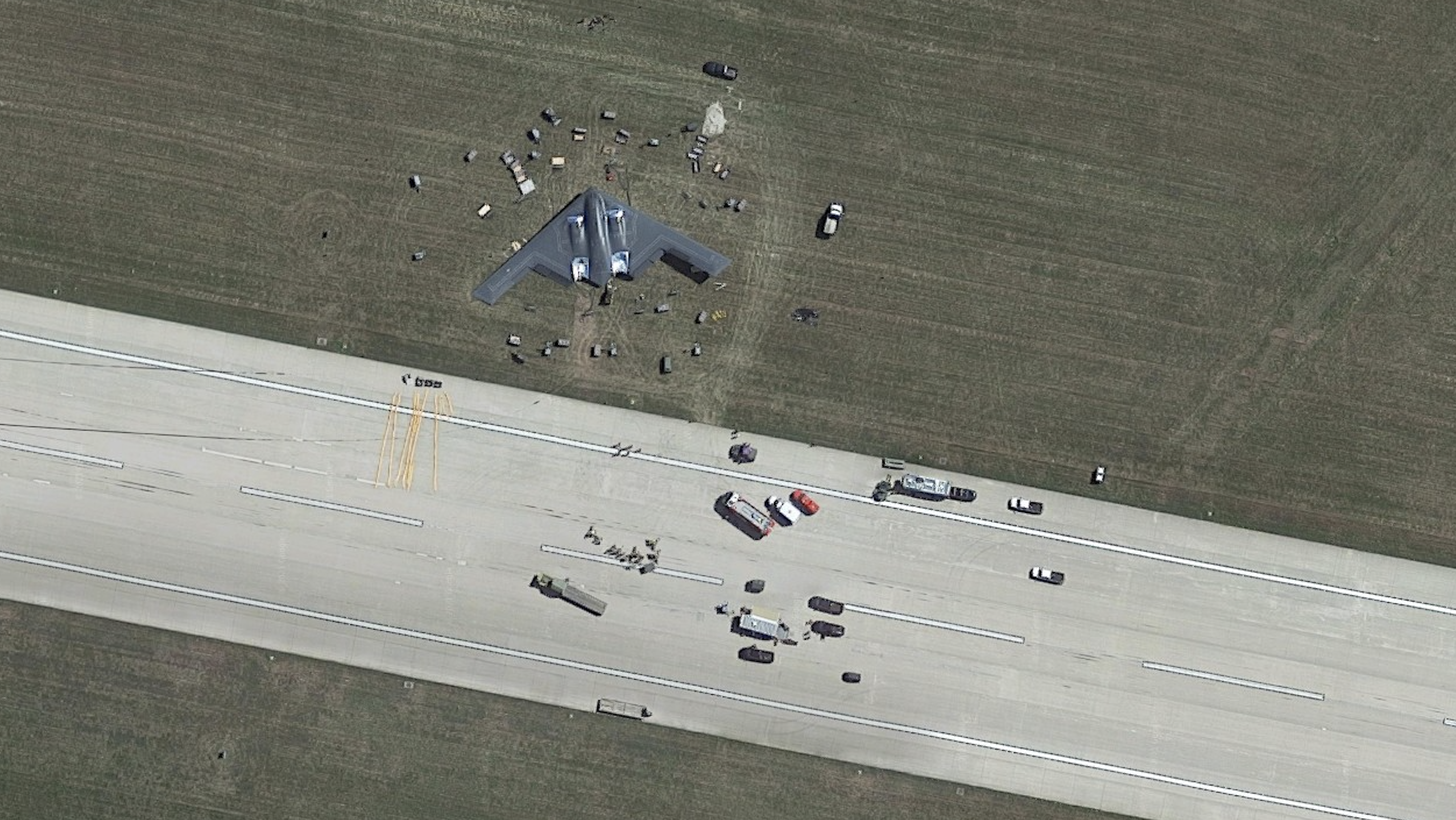
Hours after a $2 billion B-2 Spirit stealth bomber crash-landed at Whiteman Air Force Base in Johnson County, Missouri, commercial satellite imagery captured the damaged aircraft lying beside the runway—offering a rare public glimpse of one of America’s most secretive weapons systems in a moment of vulnerability.
The Story of the Incident
The incident occurred around 12:30 a.m. on September 14, 2021, when the B-2 Spirit with tail number 89-0129—known as the Spirit of Georgia—experienced a hydraulic failure during a routine training mission at Whiteman Air Force Base, located just south of Knob Noster, Missouri.
A critical lock on the left main landing gear failed on touchdown during an emergency landing, causing the gear to collapse and the aircraft’s left wing to scrape the runway. The bomber skidded off the runway and came to rest on the grass, its left wing down on the ground.
No personnel were injured and no fire broke out immediately following the crash. The aircraft was not carrying weapons at the time of the incident.
Satellite Imagery Reveals the Damage
The War Zone was the first to report on the mishap and published satellite imagery showing the bomber lying on the grass next to the runway. Satellite imagery from Planet Labs, taken at 8:24 a.m. local time on September 15, 2021, captured the damaged B-2 in striking detail—a rare public view of a crash involving one of only 20 operational stealth bombers in existence.
The imagery showed the extent of the damage: the collapsed left main landing gear, the aircraft sitting at an angle with its left wing against the ground, and emergency response equipment surrounding the bomber.
The Air Force issued a Notice to Airmen (NOTAM) shortly after the accident, restricting airspace within six miles of the base to “provide a safe environment for accident investigation.”
Emergency Response and Initial Assessment
Emergency crews from the 509th Maintenance Group and the B-2 System Program Office quickly lifted the aircraft using airbags, manually secured the landing gear, and moved the bomber into a hangar for inspection.
Damage surveys and non-destructive inspections found significant structural harm around the left main landing gear bay and the lower wing, said Col. Jason Shirley, senior materiel leader for the B-2 System Program Office.
The immediate question: Could this aircraft be saved, or would it become the second total loss in B-2 history?
The Decision to Repair
Months of inspections and structural modeling followed. Engineers used finite-element analysis to confirm that there was no damage to the outboard wing spars—a key structural finding that made repair feasible rather than writing off the aircraft entirely.
Temporary fixes were designed to allow the aircraft to make a one-time ferry flight to Northrop Grumman’s Palmdale, California, facility on September 22, 2022—more than a year after the crash. Officials said this approach saved an estimated $52 million and reduced the schedule by nine months compared to attempting repairs at Whiteman or disassembling the aircraft for transport.
The Four-Year Restoration
Once in Palmdale, permanent repairs proceeded in four phases: design, test validation, structural restoration, and airworthiness certification, for a total cost of approximately $24 million.
One innovative solution involved harvesting an 8-by-4-foot composite skin panel from Test Article 0998, thereby avoiding the time-consuming fabrication of an entirely new part. The donor panel restored the structural integrity of the lower wing skin, which carries aerodynamic loads and seals internal fuel tanks.
Technicians also replaced the left wingtip, major wing-skin sections, and landing-gear door hinges while repairing composite disbonds throughout the affected area. All structural repairs were completed on May 12, 2025.
Technical Challenges
Composite repair work required tightly controlled heat distribution inside confined spaces near critical structural joints, said Matt Powers, a structures engineer with the B-2 program office.
Teams used custom heating equipment, thermal surveys, and precise insulation and airflow management to complete the cure safely.
Fuel-tank contamination presented another hurdle. Restoring composite surfaces inside tank areas to near laboratory-grade cleanliness was necessary before bonding new material.
Because autoclave use was impossible, Northrop Grumman applied a resin formulation previously validated for out-of-autoclave repair on other platforms—a decision that shortened the schedule and reduced rework risk.
Return to Service
The Spirit of Georgia flew again on November 6, 2025—four years and two months after commercial satellites captured it lying damaged beside a Missouri runway.
“This repair effort is more than restoring a single aircraft,” Shirley said. “It ensures the B-2 fleet remains viable for decades to come.”
Strategic Significance
The successful restoration carries weight beyond a single airframe. The B-2 fleet consists of just 20 operational aircraft—21 were built, but one was destroyed in a 2008 crash at Guam. Each bomber represents approximately 5% of America’s stealth strategic bombing capability.
With each B-2 costing approximately $2.1 billion in total program cost and no new aircraft ever to be built, losing the Spirit of Georgia would have been a permanent reduction in strategic capability until the B-21 Raider reaches full operational capacity in the 2030s.
Bottom Line
From satellite imagery showing a crashed stealth bomber on a Missouri runway to a successful return to flight four years later, the restoration of the Spirit of Georgia demonstrates the Air Force’s commitment to maintaining every available strategic asset. The repair techniques developed during this effort—including out-of-autoclave composite bonding, precision thermal management, and innovative parts harvesting—will inform future B-2 sustainment operations and help keep the small fleet viable as it transitions toward eventual replacement by the B-21 Raider.


