
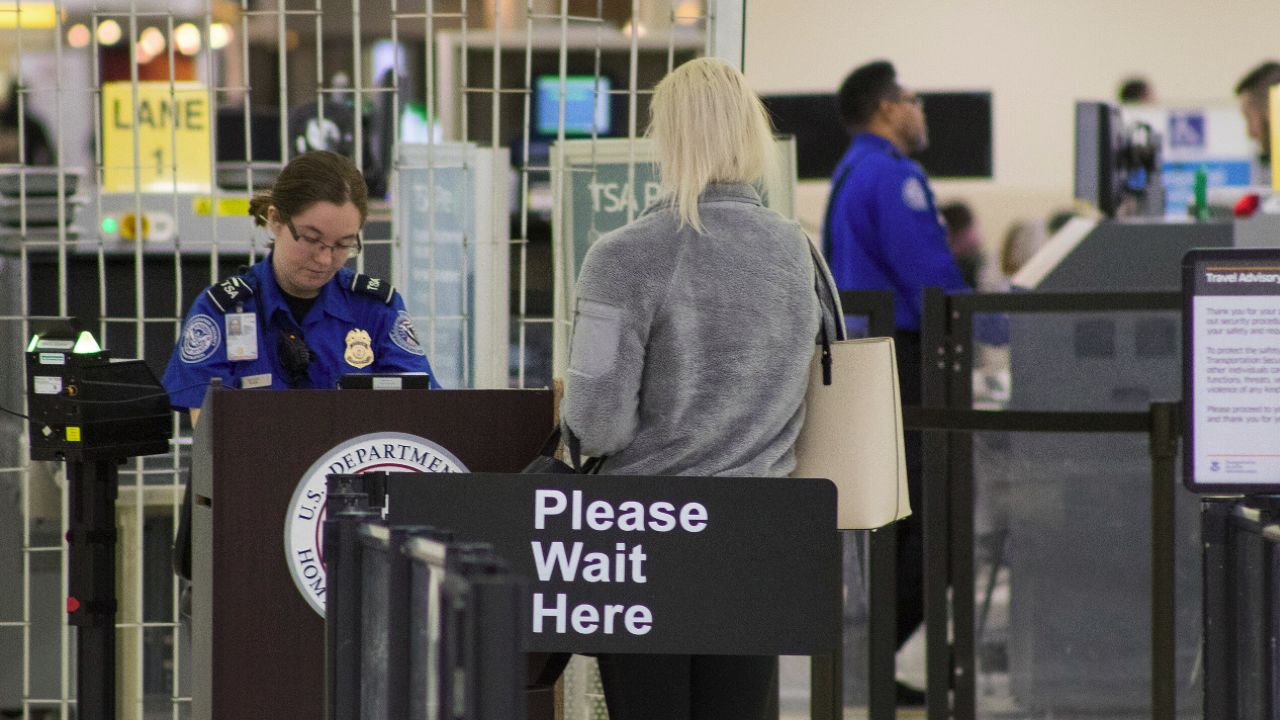
U.S. Homeland Security Secretary Kristi Noem on Friday terminated the collective bargaining agreement covering 47,000 Transportation Security Administration officers, the department said in a statement.
The American Federation of Government Employees, which represents the airport screening officers, said it would file a lawsuit to challenge the decision. The Department of Homeland Security said it would implement the new labor framework on January 11 and would no longer be collecting union dues from TSA officers’ paychecks.
In June, a U.S. judge issued a preliminary injunction blocking Noem’s March 7 attempt to end the collective bargaining agreement. On Thursday, the U.S. House of Representatives voted to restore collective bargaining rights to about 1 million unionized federal employees, including TSA, seeking to repeal an executive order issued by President Donald Trump in March. Lawmakers said Trump’s action sought to repeal collective bargaining rights of 67% of federal workers.
Federal workers face significant limitations in labor rights and are prohibited from bargaining over wages, benefits, or job classifications and are barred from striking.
“Secretary Noem’s decision to rip up the union contract for 47,000 TSA officers is an illegal act of retaliatory union-busting that should cause concern for every person who steps foot in an airport,” AFGE National President Everett Kelley said in a statement.
TSA said on Friday the new labor framework “will return the agency back into a security-focused framework that prioritizes workforce readiness, resource allocation and mission focus with an effective stewardship of taxpayer dollars.”
Trump on January 20 forced out TSA administrator David Pekoske, whom he had named to the job in 2017 and was reappointed by former President Joe Biden. Trump has not yet named a candidate to replace Pekoske.
The TSA reached a new seven-year labor deal in May 2024 with AFGE after nearly a year of negotiations. The Biden administration expanded the scope of bargaining permitted in 2022 with TSA workers. Workers got enhanced shift trade options, increased allowance for uniforms and the addition of parental bereavement leave and weather and safety leave as part of the labor deal.
According to Bloomberg Law, the Transportation Security Administration suspended the labor union representing 47,000 officers for the second time, even though a federal judge ordered the government to recognize the union. The TSA Friday announced a “new labor framework,” set to begin Jan. 11, that will expel the existing union and end dues deductions from employee paychecks.
“Our Transportation Security Officers need to be focused on their mission of keeping travelers safe not wasting countless hours on non-mission critical work,” Adam Stahl, acting deputy administrator of the TSA, said in a statement. “Under the leadership of Secretary Noem, we are ridding the agency of wasteful and time-consuming activities that distracted our officers from their crucial work.”
The move comes despite a June district court order halting an earlier Trump administration effort to end the TSA union. In an internal fact sheet obtained by Bloomberg Law, the TSA says that the court order applies only to a Feb. 27 policy by Homeland Security Secretary Kristi Noem, not the new one made public Friday.
The document claims Noem had already rescinded the February policy, allowing her to repeal the 2024 labor contract and remove the American Federation of Government Employees as the TSA’s union. The two policies, while similar, are “separate and distinct labor determinations,” the document states.
A union official, speaking on the condition of anonymity, said the AFGE had not been made aware of the earlier policy determination, written in September. The group believes the latest abolition of the TSA union is illegal.
The move comes during a wider battle over Trump’s effort to purge government unions. A federal appeals court on Monday is scheduled to hear multiple challenges to two of the president’s executive orders that stripped collective bargaining rights from about 1 million government workers.
A federal district judge in April blocked Trump’s executive order, saying it was aimed at “unrelated policy goals” and political retribution. But an appeals court later lifted the freeze while the legal challenge continued, saying the government would likely prevail. The court hold on disbanding the TSA union is part of a different legal challenge. That hold remains in place.
Trump’s orders rely on a broad definition of national security that covers an estimated two-thirds of the government workforce. Unions will have to convince the court that the president overextended his executive power. Trump’s attorneys argue he has broad authority to determine what constitutes national security.
Noem, in her signed September policy declaration, said TSA is increasingly tested by record passenger numbers, and that a union prevents the department from quickly adapting. “Continuing to allow collective bargaining and exclusive representation for screening officers,” Noem wrote in a copy of the memo obtained by Bloomberg Law, “is not compatible with ensuring that the Agency maintains the maximum agility required to secure the traveling public from constantly evolving threats.”


