
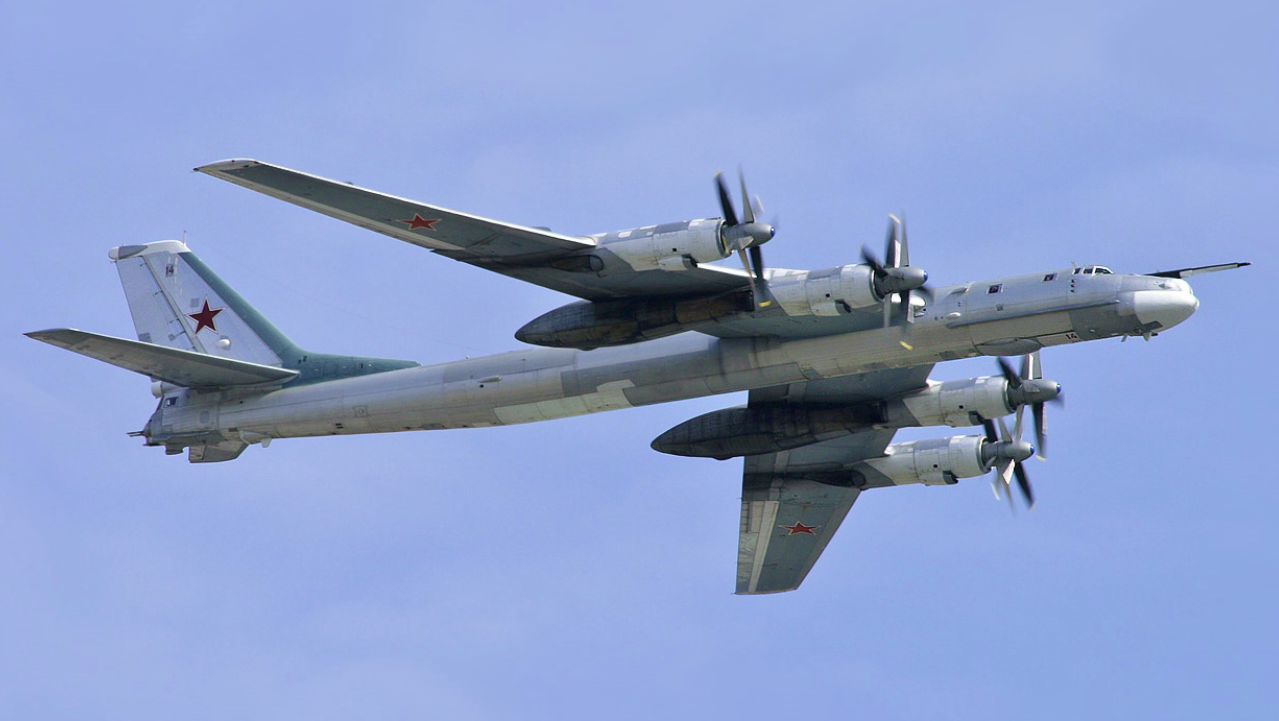
For decades, the Tupolev Tu-95 “Bear” was the face of Soviet strategic intimidation—a massive turboprop bomber that triggered thousands of NATO scrambles during the Cold War. Its distinctive contra-rotating propellers and thunderous engines made it impossible to miss. But in 2024-2025, Ukraine achieved what Western air defenses merely contained: systematically destroying Russia’s Tu-95 fleet on the ground.
The Cold War’s Most Enduring Symbol
The ritual of intercepting the Bear was played out thousands of times between 1961 and 1991 as US and Canadian fighters scrambled to engage Soviet bombers probing the periphery of North American airspace. Photos of Bear bombers intercepted by Western fighters are among the most recognizable images of the Cold War—American F-102s, F-106s, F-4s, and later F-15s flying wingtip-to-wingtip with massive Soviet bombers over the Bering Sea and the GIUK gap (Greenland-Iceland-UK).
The Tu-95 first flew in 1952 and entered service in 1956, designed as a long-range strategic bomber capable of delivering nuclear weapons to the continental United States. At 164 feet long with a range exceeding 8,000 miles, the Bear could reach targets deep in North America and return to Soviet territory.
An Acoustic Monster
What made the Tu-95 truly distinctive was its propulsion: four Kuznetsov NK-12 turboprop engines—the most powerful turboprops ever built—driving massive contra-rotating propellers. The aircraft is so loud that US submarines can reportedly hear it flying overhead, and it has “the radar signature of a flying big-box store.”
For stealth, the Tu-95 was a disaster. For strategic messaging during the Cold War, it was perfect.
The Intercept Ritual
NATO intercepts of Tu-95s became routine throughout the Cold War. Both sides would take pictures while flying in close formation, a carefully choreographed dance that demonstrated capability without escalating to conflict. Soviet bombers would approach NATO airspace, Western fighters would scramble to intercept, escort photos would be taken, and the Bears would turn back.
This ritual continued well beyond the Soviet Union’s collapse. As recently as 2021, NATO jets scrambled ten times in a single day to intercept Russian Tu-95s during an unusual surge of activity over European seas. Rare photos from Cold War intercepts show NATO fighters—including British Phantoms and American F-15s—shadowing Soviet Tu-95RT Bear-D reconnaissance variants over international waters.
Russia’s Continued Reliance on the Bear
Russia inherited approximately 60 Tu-95MS aircraft from the Soviet Union and continues to operate 50+ today, now primarily as cruise missile carriers rather than gravity-bomb platforms. The Tu-95MS can carry up to eight Kh-101 or Kh-555 cruise missiles—weapons with ranges exceeding 2,500 km that allow the bomber to strike targets deep in Ukraine without entering contested airspace.
Throughout the full-scale invasion of Ukraine that began in February 2022, Russia has relied heavily on Tu-95s to launch mass cruise missile strikes against Ukrainian cities and infrastructure. Ukraine’s Air Force spotted 11 Tu-95MS strategic bombers launching missiles at 5 a.m. on August 26, 2024, part of what became one of the largest aerial attacks of the war.
Ukraine Strikes Back
What Western air defenses merely contained during the Cold War, Ukraine set out to destroy. Beginning in 2023, Ukrainian forces launched an ambitious campaign to strike Russian strategic bomber bases deep inside Russia—hundreds of kilometers from the front lines.
On April 5, 2024, Ukraine conducted one of the largest drone strikes against Russian military facilities, targeting at least four Russian airbases simultaneously. Ukrainian Security Service (SBU) sources reported successful strikes on Engels-2, Belaya, Olenya, and other strategic bomber bases.
But the most devastating blow came on June 1, 2025. Ukrainian forces launched Operation Spider Web, a coordinated drone assault on multiple Russian airbases that struck an estimated 8-9 Tu-95MS bombers, with three destroyed beyond repair. According to detailed analysis, this single operation destroyed more than 50% of Russia’s fully mission-capable Tu-95MS airframes.
The strike represented approximately 16% of Russia’s entire active Tu-95 fleet—a devastating loss of strategic capability achieved not through air-to-air combat but through long-range precision strikes on what Russia thought were secure rear-area bases.
Halting Modernization
Ukraine didn’t stop at destroying airframes. On November 25, 2025, Ukrainian forces struck the Beriev plant in Taganrog, the only facility in Russia engaged in modernization and repair of Tu-95MS strategic bombers. The strike effectively halted Russia’s ability to upgrade and maintain its remaining Bear fleet, compounding the losses from earlier airbase strikes.
The Strategic Impact
For seven decades, the Tu-95 Bear represented Soviet and Russian strategic reach—a symbol of Moscow’s ability to project power globally and strike targets thousands of miles from Russian territory. Western air defenses could intercept and turn back these bombers, but never threatened to eliminate them entirely.
Ukraine changed that calculus. Through a combination of long-range drone strikes, modified air defense systems, and attacks on maintenance infrastructure, Ukrainian forces systematically degraded Russia’s Tu-95 fleet—achieving destruction rather than mere deterrence.
The Bear that couldn’t be stopped during the Cold War has finally met its match, not in the contested airspace over Alaska or the North Atlantic, but on the tarmac of Russian airbases, hundreds of kilometers behind what Moscow thought were secure lines. The aircraft that once symbolized Soviet strategic invincibility now represents Russia’s vulnerability to deep strikes—a dramatic reversal in the long arc of the bomber’s operational history.


