
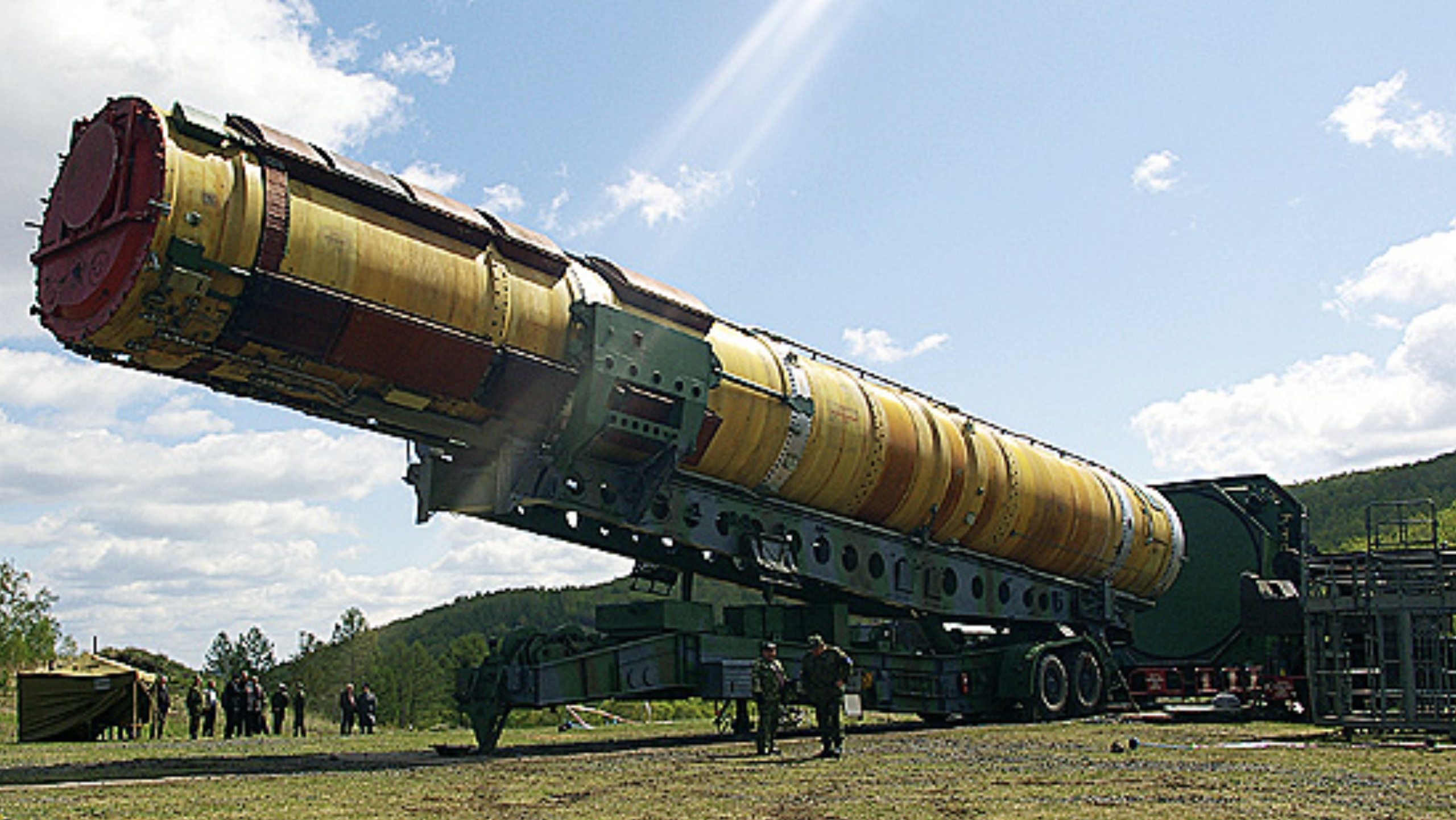
Russia’s flagship nuclear modernization program has suffered a catastrophic setback following the apparent explosion of an RS-28 Sarmat intercontinental ballistic missile (ICBM) during a pre-launch sequence. Satellite imagery obtained from Maxar Technologies and Planet Labs reveals a massive 200-meter-wide crater at the Plesetsk Cosmodrome, confirming the total destruction of a specialized launch silo.
The event, which occurred in late September 2024, marks the fifth major failure for the weapon system NATO designates as “Satan II.” While President Vladimir Putin has previously touted the missile as “invincible” and “unstoppable,” military analysts suggest the program is now facing a systemic crisis that threatens the timeline of Russia’s nuclear triad modernization.
Conclusive Evidence of a Silo Disaster
The failure was first flagged by open-source intelligence (OSINT) analysts monitoring NASA’s Fire Information for Resource Management System (FIRMS), which detected intense thermal signatures at the launch site. Subsequent high-resolution photography showed that the missile likely detonated inside or immediately above the silo, causing extensive damage to the surrounding infrastructure.
According to George William Herbert of the Middlebury Institute of International Studies, the explosion appears to have occurred during the liquid-fueling process or shortly after engine ignition. The Sarmat utilizes highly volatile liquid propellants, a design choice that offers immense range and payload capacity but introduces significant handling risks.
A Pattern of Technical Collapse
The September disaster is the latest in a string of high-profile failures for the $1 billion-plus development program. Since the project began, Russia has attempted five full-scale tests, with a success rate of only 20 percent:
- April 2022: The only confirmed successful flight test.
- February 2023: A failed test timed to coincide with U.S. President Joe Biden’s visit to Kyiv.
- Late 2023 – Early 2024: Two aborted or failed tests reported by Western intelligence.
- September 2024: The catastrophic silo explosion at Plesetsk.
The International Institute for Strategic Studies (IISS) notes that the aging Soviet-era R-36M “Voevoda” missiles, which the Sarmat is intended to replace, are reaching the end of their service lives. The inability to field a reliable successor leaves a growing gap in Russia’s strategic deterrence capabilities.
Industrial Struggles and Sanctions
The repeated failures highlight the friction between the Kremlin’s strategic ambitions and its industrial reality. Defense experts at the Center for Strategic and International Studies (CSIS) suggest that Western sanctions on high-precision electronics and specialized sensors may be degrading Russia’s ability to manufacture the sophisticated guidance and fueling systems required for heavy ICBMs.
Furthermore, the original “Satan” missiles were manufactured in Ukraine at the Yuzhmash plant. Following the 2014 invasion of Crimea and the 2022 full-scale invasion, Russia lost access to the engineering expertise and supply chains that maintained the original fleet, forcing a “from-scratch” development of the RS-28 that has proven difficult to master.
Strategic Implications
Despite the Kremlin’s 2023 announcement that the Sarmat had been placed on “experimental combat duty,” the Institute for the Study of War (ISW) characterizes these claims as psychological warfare rather than military reality. A weapon system with a singular successful test cannot be reliably deployed as a primary deterrent.
The destruction of the silo at Plesetsk is expected to delay the program by at least 18 months. As Russia pivots its rhetoric toward changing its nuclear doctrine to lower the threshold for use, the physical state of its newest delivery vehicle serves as a stark reminder of the technical hurdles facing Putin’s military-industrial complex.


