
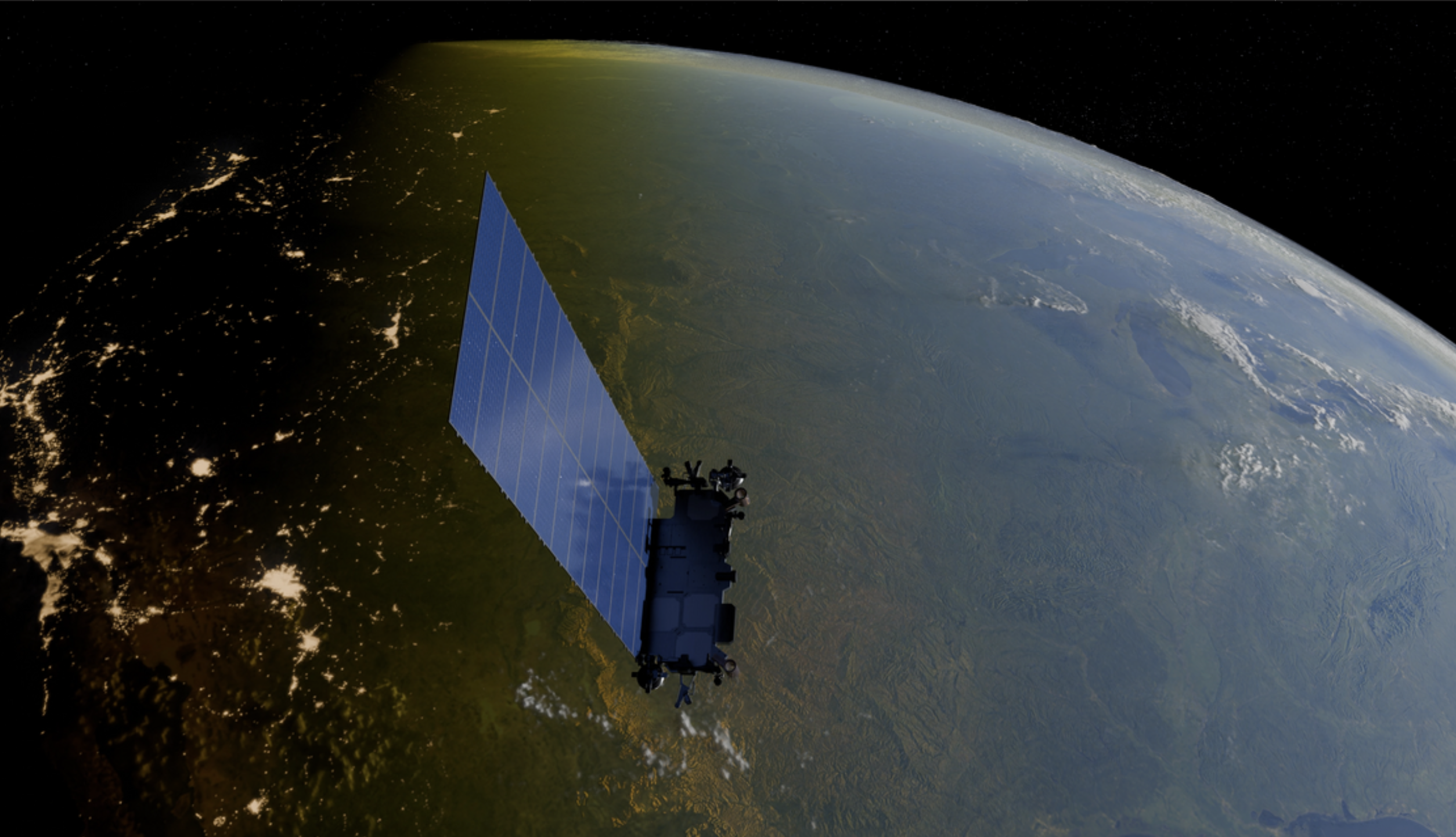
Space has never felt more like a crowded on-ramp.
Over the past decade, the number of satellites in low Earth orbit has exploded, led by mega-constellations like SpaceX’s Starlink. A new analysis from a team including researchers at Princeton warns that this congestion is now sitting on a razor’s edge—and that a single, well-timed solar storm could be enough to kick off a cascading disaster.
A “House of Cards” in orbit
The basic problem is simple: there are too many spacecraft trying to share too little orbital real estate.
According to a 2023 Federal Communications Commission filing, Starlink satellites alone performed roughly 50,000 collision-avoidance maneuvers over the previous four years. That is an astonishing number of last-second course corrections for a single system.
Hugh Lewis, a professor of astronautics at the University of Southampton, calculated that if current launch and deployment trends continue, Starlink satellites could be executing on the order of a million collision-avoidance maneuvers every six months by 2028. At that tempo, there is almost no room for human or machine error. A bad data point, a delayed command, or a disabled thruster can quickly escalate into much bigger problems.
This is where the specter of Kessler Syndrome comes in—a runaway chain reaction where one collision generates debris, that debris hits something else, and within a short span of time you have a belt of shrapnel tearing through any satellite unlucky enough to be in the wrong orbit.
How solar storms push us toward Kessler Syndrome
The new work highlighted by Interesting Engineering argues that solar storms may be the catalyst that tips this already-fragile system into true orbital chaos.
When a major solar storm hits Earth, it heats and puffs up the upper atmosphere. That in turn increases atmospheric drag on satellites in low Earth orbit. Spacecraft have to burn more fuel just to maintain altitude, and any satellite already running tight on propellant suddenly has much less margin for maneuver.
The researchers point to the May 2024 “Gannon Storm,” which forced more than half of all satellites in LEO to expend fuel to reposition and compensate for the drag spike. That gives us a real-world test case: a single storm pushed hundreds or thousands of vehicles to adjust orbits in a compressed window of time.
At the same moment, solar storms can degrade or outright damage satellites’ navigation, communication, and attitude-control systems. If spacecraft lose reliable contact with ground controllers or suffer sensor outages, they may not be able to respond in time to collision warnings—if they can respond at all.
Now put those two effects together: more drag and more fuel burn, plus a higher probability that some fraction of the fleet cannot steer. In an environment already saturated with active satellites and dead hardware, that combination nudges us much closer to the Kessler edge.
The CRASH Clock: how long until a catastrophic hit?
To make this risk legible, the team introduced a blunt but useful metric: the Collision Realization and Significant Harm (CRASH) Clock.
The idea is straightforward. Imagine that, for whatever reason, satellite operators suddenly lose the ability to command evasive maneuvers across the LEO population. The CRASH Clock estimates how long it would take before a catastrophic collision becomes likely under those conditions.
Their calculation is sobering. As of June 2025, the CRASH Clock for low Earth orbit sits at 2.8 days. That is not a typo. In a no-maneuver, business-as-usual-traffic scenario, it would take on the order of a long weekend for the odds of a major collision to spike.
Compare that to 2018, when the same metric would have been around 121 days. What changed? The biggest inflection point was the deployment of Starlink’s mega-constellation, which began launching in earnest in 2019. As more spacecraft are added, the clock keeps ticking down.
The implication is stark: a powerful solar storm that temporarily degrades command links, sensors, or propulsion for a subset of satellites could easily push us into a Kessler-style chain reaction. In a worst-case scenario, it would only take a matter of days for the orbital house of cards to start collapsing.
What a Kessler event would actually mean
Kessler Syndrome gets thrown around a lot in science fiction, but the stakes are very real.
A large-scale cascading collision in congested LEO would generate clouds of high-velocity debris that are extremely difficult to track and almost impossible to dodge in real time. That, in turn, could:
- Threaten existing constellations like Starlink, OneWeb, and others
- Curtail new launches into popular orbital bands because the collision risk becomes unacceptable
- Jeopardize crewed missions in low Earth orbit, including stations or commercial habitats
In an extreme scenario, some altitude ranges could become effectively unusable for years or decades, either for commercial operators or for national space programs.
Living with a shorter clock
The researchers’ pre-print is not a prediction that Kessler Syndrome is inevitable. It is a warning that the margin between “risky” and “unmanageable” is shrinking faster than policymakers and operators are acting.
If the CRASH Clock is already down to 2.8 days today, and if launch cadence plus mega-constellation growth continues on its current trajectory, then every additional satellite we send up without a serious debris-mitigation strategy is another card stacked on a table we know is wobbling.
Solar storms are not new. What is new is the density and economic importance of the infrastructure we have put in their path. That combination—hyper-dense constellations like Starlink on one side, and increasingly well-documented space weather risks on the other—is what makes the Princeton team’s warning worth taking seriously.
The space economy is being built on orbits that are far less forgiving than they were even a decade ago. The question now is whether operators and regulators treat the Crash Clock as a curiosity—or as a countdown.


