

Mississippi’s governor took aim at California Gov. Gavin Newsom, using state reading statistics to challenge both his policy record and his recent public remarks. The governor published a post asserting that “a Black student in Mississippi is 2.5 times more likely to read proficiently by fourth grade than if he or she lived in California,” and added, “we would be happy to send one of our reading coaches to assist you, @GavinNewsom.” He concluded his message by saying, “One nice feature of increased literacy is that you do not have to fall back on vulgarity to seem passionate.”
This seems like a good time to remind you that a black student in Mississippi is 2.5X more likely to read proficiently by 4th grade than if he or she lived in California. We would be happy to send one of our reading coaches to assist you, @GavinNewsom. Learning is a lifelong… https://t.co/3FqgFQZDEy
— Governor Tate Reeves (@tatereeves) February 23, 2026
The remarks were directed at Newsom following a contentious exchange in which he responded to criticism from Fox News host Sean Hannity over a comment Newsom made about his own academic performance. Newsom had described himself as “a 960 SAT guy” while discussing his lifelong struggle with dyslexia, saying he was “not trying to offend anyone” and emphasizing that reading aloud has been difficult for him due to that condition. His office later rebutted the outrage as what it called “MAGA‑manufactured outrage,” and pushed back against attacks framing his comments as racially insensitive.
You didn’t give a shit about the President of the United States of America posting an ape video of President Obama or calling African nations shitholes — but you’re going to call me racist for talking about my lifelong struggle with dyslexia?
— Gavin Newsom (@GavinNewsom) February 23, 2026
Spare me your fake fucking outrage,… https://t.co/ABNZJQJLcj
The governor’s comparison revived broader debates about education outcomes between states. Mississippi’s fourth‑grade reading proficiency has been a frequent subject of national attention as the state’s scores have risen significantly on the National Assessment of Educational Progress (NAEP), sometimes called the Nation’s Report Card. Recent results show that roughly 19 percent of Black fourth‑grade students in Mississippi scored at or above the NAEP proficient level in reading in 2024, according to state breakdowns of NAEP data.
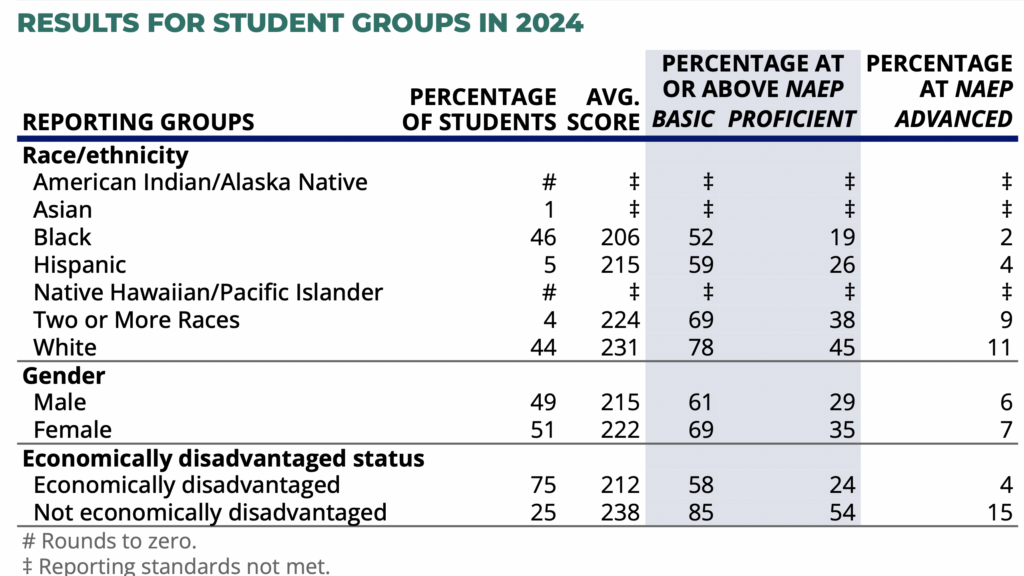
Scores in Mississippi have climbed from some of the lowest in the nation in previous years to rankings substantially higher in more recent assessments. By contrast, data compiled from national assessments have shown that reading proficiency rates for Black students in states like California have lagged behind national averages. For example, commentary on statewide results indicated that a relatively small share of Black fourth graders in California were proficient on recent assessments, compared with much larger shares in Mississippi, though exact ratios can vary depending on the dataset examined and the definition of proficiency used.
The exchange between Mississippi’s governor and Newsom highlights how academic achievement data is increasingly entering national political discourse, with state leaders using comparative statistics to bolster broader arguments about education policy and leadership. As both sides continue to debate the meaning and implications of these figures, educators and policymakers point to longstanding challenges in raising literacy outcomes across the United States and the complex array of strategies being pursued to address them.


