
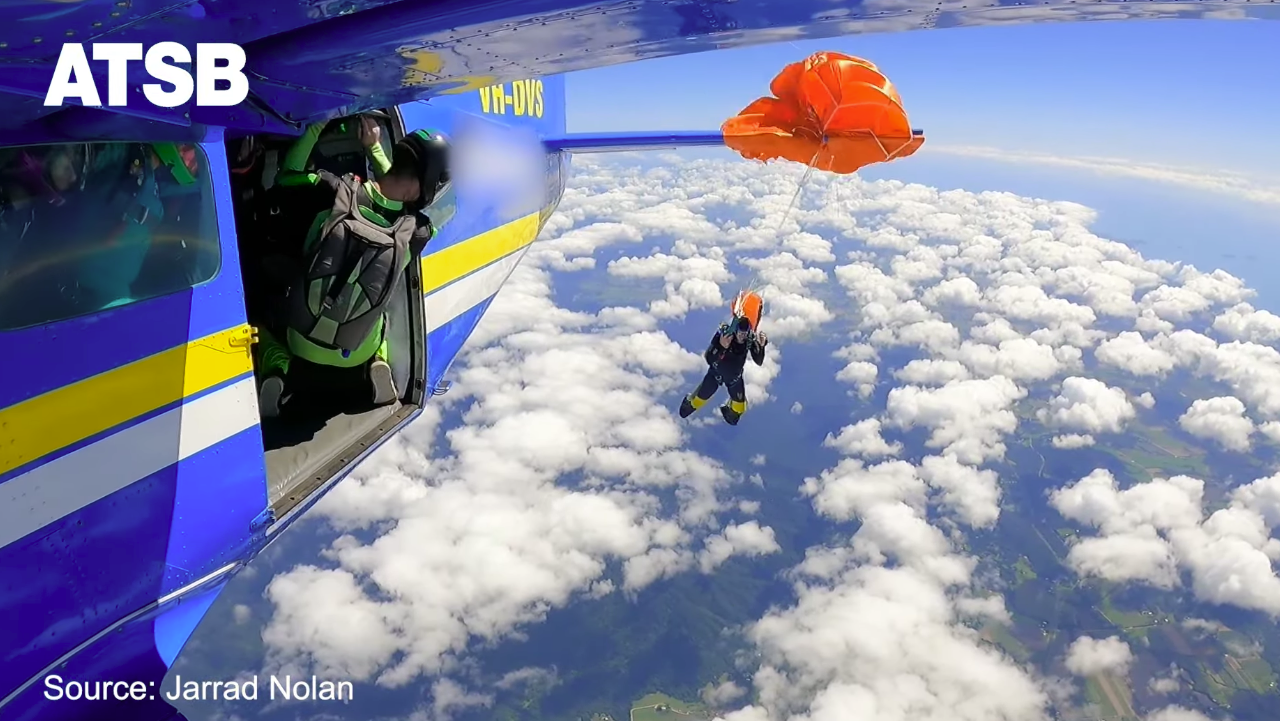
The incident occurred during a formation skydiving event over Mission Beach in Far North Queensland, 140 kilometers south of Cairns, according to an Australian Transport Safety Bureau investigation released Thursday.
A Cessna Caravan carrying 17 parachutists had reached jump altitude for a 16-way formation jump when the first skydiver’s reserve parachute handle snagged on a wing flap as he climbed out of the roller door, inadvertently deploying the chute.
The parachutist was dragged backward, his legs striking the aircraft’s left horizontal stabilizer and substantially damaging it. The parachute wrapped around the stabilizer, suspending him below the aircraft at 15,000 feet.
Mid-air rescue
Video footage released by the ATSB shows the skydiver hanging beneath the plane as another parachutist fell from the aircraft during the chaos.
The pilot felt the aircraft suddenly pitch up and observed airspeed rapidly decreasing. Initially believing the plane had stalled, the pilot applied power before being told a skydiver was caught on the tail.
Two parachutists remained in the doorway watching as the snagged jumper used a hook knife to cut 11 lines from his reserve parachute. The remaining parachute tore free, sending him into freefall.
He successfully deployed his main parachute, which inflated despite becoming tangled in the remaining lines and canopy of the reserve chute. He landed safely with only minor injuries.
Thirteen other parachutists exited the aircraft during the emergency.
Damaged aircraft lands safely
With a portion of the reserve parachute still wrapped around the damaged tailplane, the pilot assessed he had limited pitch control.
The pilot, wearing an emergency parachute in case evacuation became necessary, declared MAYDAY to Brisbane Air Traffic Control and managed a gradual descent.
“In difficult circumstances, the pilot managed to control the aircraft and land safely at Tully,” ATSB Chief Commissioner Angus Mitchell said.
Investigation findings
The investigation found the pilot and aircraft operator did not ensure the aircraft was loaded within its weight and balance envelope, though this did not contribute to the accident. The pilot also did not use oxygen at the flight level as required.
The Australian Parachute Federation assessed that the bulky handle design “may have increased the risk of snagging” if not adequately protected.
Mitchell emphasized that carrying a hook knife, though not a regulatory requirement, “could be lifesaving” in the event of a premature reserve parachute deployment.
Australian Parachute Federation CEO Stephen Porter called the incident “unique and extreme”, crediting the positive outcome to the skydiver’s experience, recent emergency training reviews, and the ability of both the jumper and pilot to remain calm under pressure.
The jump was part of the “Big Ways at the Beach” multi-day event in which experienced parachutists complete large group formations.


