

In 1960, the Soviet Union shot down an American U-2 spy plane flown by Francis Gary Powers, shattering the myth that high-altitude reconnaissance aircraft were untouchable. The U-2 had been designed to fly above 70,000 feet—beyond the reach of Soviet fighters and surface-to-air missiles. But the Powers incident proved that altitude alone wasn’t enough. The Soviets had developed the SA-2 missile, and America’s most advanced spy plane had been vulnerable all along.
The solution was the SR-71 Blackbird—an aircraft so fast and so high that no enemy weapon system could touch it. Over 25 years of operational service, the SR-71 was never shot down despite having more than 4,000 missiles fired at it. When an SR-71 detected a missile launch, the pilot’s response was simple: accelerate.
The Speed Record That Still Stands
The SR-71 Blackbird holds the record as the fastest jet aircraft in history, reaching speeds exceeding Mach 3.3—more than 2,100 mph. That’s almost four times faster than a commercial airliner and faster than a rifle bullet. The aircraft could fly from New York to London in less than two hours.
The official speed record was set on July 28, 1976, when an SR-71 reached 2,193.2 mph (Mach 3.3) at 85,000 feet. The same aircraft set the altitude record that still stands today: 85,068.997 feet—over 16 miles high, well into the stratosphere.
These records have stood for nearly 50 years. No air-breathing manned aircraft has flown faster or higher since.
Design and Engineering
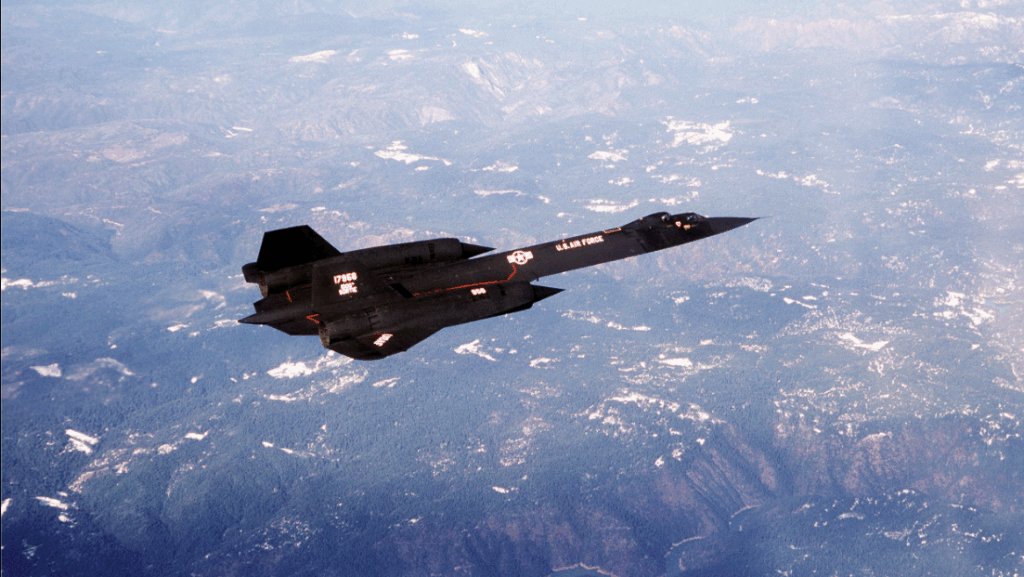
Description: An air-to-air right top view of an SR-71 Blackbird during its 1,000th sortie over Beale Air Force Base, California. Released by the U.S. Department of Defense / American Forces Information Service / Defense Visual Information Center.
The SR-71 was developed by Lockheed’s Skunk Works division under the legendary aerospace engineer Clarence “Kelly” Johnson. The aircraft first flew on December 22, 1964, and entered service with the U.S. Air Force in January 1966.
Flying at Mach 3+ generates extreme heat from air friction. The SR-71’s exterior surfaces reached temperatures of 600°Fduring flight. To handle this, the aircraft was constructed almost entirely from titanium—a lightweight, heat-resistant metal that was difficult to work with and expensive to source.
Ironically, much of the titanium came from the Soviet Union. The CIA set up shell companies to purchase materials from the very nation the aircraft was designed to spy on.
The distinctive black paint wasn’t just for aesthetics. The special coating absorbed radar energy, reducing the aircraft’s radar signature and making it harder to detect—an early application of stealth technology.
The Engines: Pratt & Whitney J58
The SR-71 was powered by two Pratt & Whitney J58 engines, each producing up to 32,500 pounds of thrust with afterburners engaged. These were not conventional jet engines—they were hybrids that functioned as turbojets at lower speeds and ramjets at high speeds.
The engines flew continuously in afterburner during missions, except when refueling. The exhaust created a distinctive diamond shock wave pattern visible behind the aircraft—a signature of supersonic flight.
Air entering the engines at Mach 3+ had to be slowed to subsonic speeds before combustion. The SR-71’s unique inlet spike system handled this by adjusting automatically to changing speeds and pressures, a critical innovation that made sustained Mach 3 flight possible.
Operational History
The SR-71 served from 1966 to 1998, conducting reconnaissance missions over hostile territory with impunity. The aircraft flew missions over:
- The Soviet Union
- China
- North Korea
- Vietnam
- Cuba
- Libya
- The Middle East
Only 32 SR-71s were built, and the aircraft conducted thousands of sorties during the Cold War. Pilots reported that enemy air defenses would light up as the Blackbird crossed into denied airspace, but no weapon could reach it.
The standard evasion procedure when an SR-71 detected a surface-to-air missile launch was to accelerate. At Mach 3+, the aircraft could simply outrun any missile that was fired.
The Crew and the Pressure Suit
The SR-71 required a two-person crew: a pilot and a reconnaissance systems officer (RSO). Both crew members wore full-pressure suits similar to those worn by astronauts, as the aircraft operated at altitudes where the atmosphere is too thin to sustain human life.
If the aircraft depressurized at 85,000 feet, the crew had only seconds to survive without protection. The pressure suits were necessary safety equipment for every flight.
Why It Was Retired
Despite its capabilities, the SR-71 was retired in 1998. Several factors contributed:
- Cost: Operating the SR-71 was extremely expensive, requiring special fuel, extensive maintenance, and highly trained crews
- Satellites: Space-based reconnaissance satellites could provide similar intelligence without risking pilots
- End of Cold War: The dissolution of the Soviet Union reduced the need for high-risk overflight missions
NASA continued flying a small number of SR-71s for research purposes until 1999, when the last Blackbird was permanently grounded.
Legacy
The SR-71 Blackbird remains an icon of American aerospace engineering and Cold War technology. Its speed and altitude records still stand nearly 50 years after they were set. The aircraft demonstrated that with the right design, an airplane could fly so fast and so high that it became effectively invulnerable to enemy defenses.
Several SR-71s are now displayed in museums, including the Smithsonian National Air and Space Museum, where visitors can see the aircraft that once flew at the edge of space and outran every missile ever fired at it.
Bottom Line
The SR-71 Blackbird was born from the failure of the U-2—a reminder that altitude alone couldn’t guarantee survival over hostile territory. The Blackbird’s solution was speed: Mach 3+ performance that turned enemy missiles into futile gestures. For 32 years, the SR-71 proved that when you can’t hide and you can’t fight, you can still win by being faster than anything trying to kill you. Its records remain unbroken, a testament to an era when American aerospace engineering pushed the boundaries of what was physically possible.


