
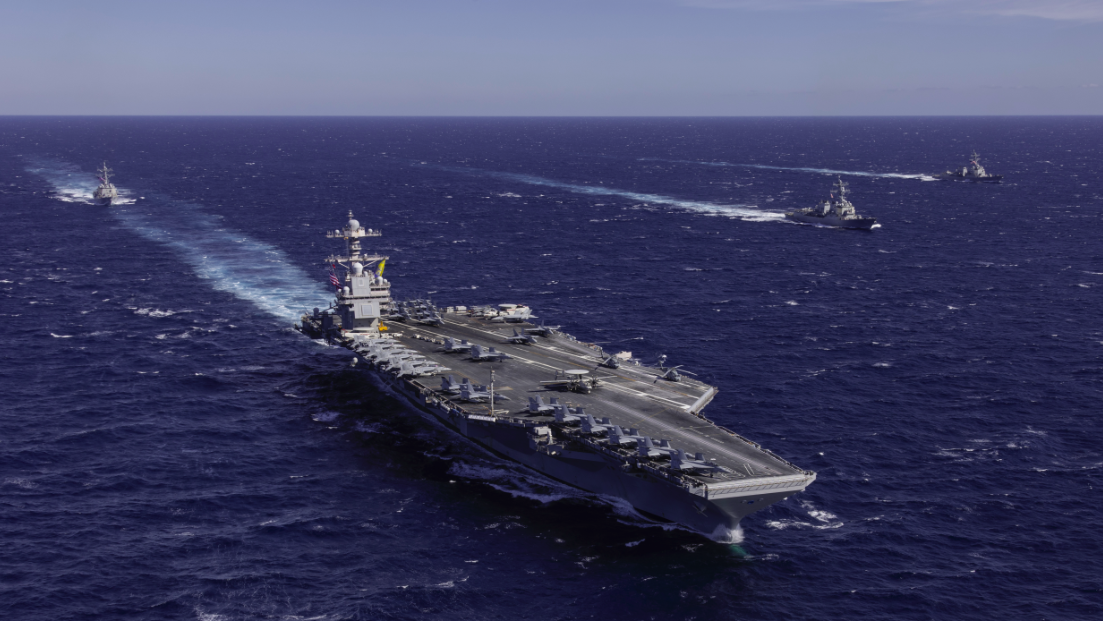
The United States has deployed its largest aircraft carrier and thousands of troops to the Caribbean as the Trump administration increases military pressure on Venezuelan President Nicolás Maduro. The buildup, which began in August and intensified through November and December, has drawn warnings from analysts that escalation could worsen regional instability and migration pressures.
As tensions continue to mount in December 2025, the military deployment shows no signs of de-escalation. Venezuela has responded by swearing in 5,600 new troops to its armed forces, while the Trump administration sends mixed signalsbetween threatening strikes and resuming deportation flights.
The Deployment
The USS Gerald R. Ford Carrier Strike Group arrived in the Caribbean in November 2025 as part of Operation Southern Spear. The deployment includes:
- The Gerald R. Ford, the world’s largest aircraft carrier
- More than 4,000 sailors
- Dozens of tactical aircraft and destroyer ships
- Multiple additional warships and a nuclear-powered submarine
The carrier strike group joined existing forces that have been stationed in the region since August, bringing the total to around 10,000 U.S. troops. The Pentagon has also rehabilitated Roosevelt Roads Naval Station in Puerto Rico, with Marines conducting amphibious landing drills at the formerly abandoned site.
Long-range bombers, including B-2 stealth bombers, have also been deployed to the region as part of the operation officially aimed at combating narcotics trafficking.
Military Strikes on Vessels
Since early September, the U.S. has carried out strikes on at least 21 Venezuelan boats it claims are trafficking drugs in the Caribbean and eastern Pacific. A timeline compiled by Military.com documents these operations, which the Trump administration says are necessary to stem the flow of drugs.
Critics have raised concerns about the legal basis for these strikes and reported civilian casualties.
Venezuelan Response
Venezuela has responded by placing its military on maximum alert and mobilizing additional forces. President Maduro has rejected what he calls a “slave’s peace” and accused Washington of planning regime change.
The Venezuelan military has been actively promoting its nationwide defense preparations on social media as tensions escalate. Interior Minister Diosdado Cabello has denied reports that Maduro might step down as part of a back-channel deal with the United States.
Deportation Flights Continue
Despite President Trump’s assertion that Venezuelan airspace should be considered closed, deportation flights carrying Venezuelan migrants have resumed. Venezuela’s government announced the flights would continue following a request from the Trump administration for twice-weekly repatriation operations.
A U.S. deportation flight carrying 172 migrants landed in Venezuela on December 6, 2025, demonstrating continued cooperation on migration issues even amid rising military tensions.
Expert Warnings
Analysts have expressed concern that military pressure may backfire. The Council on Foreign Relations warned that the Trump administration now has an opportunity to learn from past mistakes in dealing with Venezuela, while the Atlantic Council noted that Maduro faces the greatest challenge to his grip on power since taking office.
Al Jazeera quoted experts warning that a U.S. strike on Venezuela could trigger instability rather than a peaceful transition, describing it as potentially “opening Pandora’s box.”
Regional Reactions
The BBC has tracked the buildup of U.S. military planes and warships near Venezuela, with satellite imagery showing at least nine U.S. military vessels operating in the Caribbean over recent weeks. The deployment has sparked speculationabout the potential for military action beyond counter-narcotics operations.
Russia and China have both issued warnings about the U.S. military presence, raising concerns about potential great power tensions in the Western Hemisphere.
Bottom Line
The U.S. military buildup near Venezuela represents the largest Caribbean deployment in years, positioning thousands of troops and advanced weapons systems within striking distance of Caracas. While officially framed as a counter-narcotics operation, the deployment has placed unprecedented pressure on the Maduro government. Whether this pressure leads to political change or regional instability remains to be seen, but the risk of miscalculation or escalation grows as military assets accumulate off Venezuela’s coast.


